
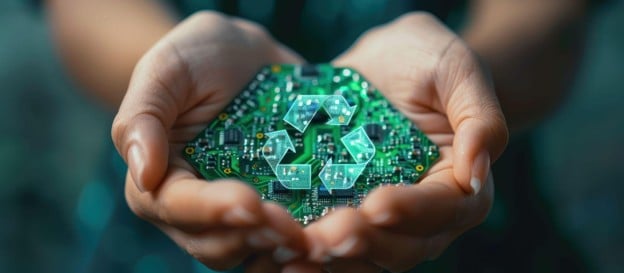
Electronic waste contains valuable metals, but recovering them responsibly remains a challenge. Arrow Recovery Group highlights an important industry question as researchers explore bioleaching, a process that uses microorganisms to release metals from discarded circuit boards, computers, and other electronics: can biological methods improve metal recovery without creating new environmental or operational challenges?
Bioleaching has attracted research interest because it may offer an alternative or complementary approach to recovering selected metals from complex waste streams. However, its potential depends on the materials being processed, the operating conditions, the quality of the recovered metals, and the practicality of scaling the process beyond laboratory experiments.
Understanding both its opportunities and limitations is essential to evaluating bioleaching’s role in the future of electronics recycling.
What Is Bioleaching, and How Does It Work?
Bioleaching uses certain microorganisms and their biological or chemical activity to help mobilize metals from solid materials. Rather than relying exclusively on mechanical separation or conventional chemical treatments, the process creates conditions in which metals can move from a solid matrix into a solution for subsequent recovery.
In electronic waste processing, researchers have investigated bioleaching for materials such as printed circuit boards, which may contain copper and smaller quantities of other valuable metals. The precise results depend on the waste composition and the microorganisms and processing conditions involved.
A simplified bioleaching process may involve several stages:
- Material preparation: Electronic components may need to be sorted, dismantled, crushed, or otherwise prepared to make target materials more accessible.
- Biological treatment: Selected microorganisms are introduced or encouraged to act under controlled conditions that support metal mobilization.
- Separation and recovery: The resulting solution is processed to separate and recover the target metals.
- Residual management: Remaining solids and liquids are assessed and managed according to their composition and applicable environmental requirements.
These steps illustrate why bioleaching is more than simply adding microorganisms to discarded electronics. Effective recovery requires careful process control and a downstream plan for handling the materials produced.
Arrow Recovery Group on Why Electronic Waste Presents a Complex Recovery Challenge
Electronic devices contain combinations of metals, polymers, glass, ceramics, and other materials. Their composition varies according to the product, its age, its intended function, and its manufacturing design.
Printed circuit boards demonstrate this complexity particularly well. They may contain useful quantities of copper alongside precious metals and other elements, but these materials are embedded in a structure that can make separation difficult.
For Arrow Recovery Group, this distinction matters because a recovery method cannot be evaluated solely by the value of the metals it might extract. The process must also account for the composition of the incoming material, the preparation required, and the treatment of everything left over.
Bioleaching may be useful for particular waste streams, but it is not automatically suitable for every electronic product. Different materials can respond differently to biological treatment, and the presence of coatings, mixed metals, or other substances may affect processing conditions.
This is why material characterization and appropriate sorting remain important, even when a recovery method uses biological processes.
What Makes Bioleaching Promising?
Interest in bioleaching stems partly from its potential to recover selected metals under conditions that may differ from those used in conventional high-temperature processing. Researchers are investigating how microbial activity and associated chemical reactions can support metal extraction from complex waste materials.
The possible advantages depend on the specific process, but several areas deserve attention:
- Targeted recovery: Biological treatment may help mobilize particular metals from selected material streams.
- Alternative processing conditions: Some bioleaching approaches operate under conditions that differ from traditional thermal recovery, although their overall resource and energy requirements must still be evaluated.
- Complementary processing: Biological methods may eventually complement mechanical separation or other recovery technologies in carefully designed systems.
- Research into difficult materials: Continued study may help identify new ways to process waste streams that present challenges for established techniques.
These possibilities should be viewed as areas of investigation rather than guaranteed commercial benefits. A process that performs well under controlled experimental conditions may face different constraints when exposed to variable feedstock, higher throughput requirements, or industrial operating costs.
A 2025 review in Resources, Conservation and Recycling examines biological approaches to recovering critical metals from electronic waste, including the opportunities and limitations associated with bioleaching. The research provides context for evaluating where these techniques may contribute to more resource-conscious recovery systems.
The Challenges of Scaling Bioleaching
The central question for the industry is not simply whether microorganisms can help release metals. It is whether a particular process can recover those metals consistently, safely, and economically under realistic operating conditions.
Several factors influence that assessment.
Processing time and throughput
Biological processes can require time to achieve the desired level of metal mobilization. Industrial facilities must consider whether the treatment period can accommodate the volume and variability of material they receive.
Material preparation
Circuit boards and other electronic components may need substantial preparation before biological treatment. Sorting, dismantling, size reduction, and other preliminary steps can influence both the accessibility of metals and the total cost of processing.
Recovery efficiency and purity
The amount of metal mobilized is not necessarily the same as the amount of usable metal ultimately recovered. Additional separation and purification may be necessary, and the quality of the final product matters when determining its commercial value.
Environmental controls
The liquids, residual solids, and other byproducts generated during processing require appropriate assessment and management. A biological recovery method should not be considered environmentally preferable without examining its complete process, including chemical inputs, energy use, water requirements, and residual treatment.
Commercial feasibility
Equipment, labor, process monitoring, operating time, and downstream recovery all contribute to the total cost. A viable industrial application must demonstrate that its performance justifies these requirements for the specific material stream being processed.
For Arrow Recovery Group, these considerations offer a useful framework for discussing new recovery technologies responsibly. Innovation matters, but its practical value depends on measurable results across the entire process.
How Bioleaching Compares With Conventional Recovery Methods
Bioleaching should not be viewed as a universal replacement for established recycling technologies. Mechanical processing, chemical extraction, and thermal methods each have different capabilities, limitations, and operating requirements.
Mechanical separation can help divide electronic waste into material fractions before further treatment. Chemical processes may support the extraction of particular metals, while thermal methods can process certain materials under high temperatures. Bioleaching introduces biological activity as another possible part of the recovery toolkit.
The appropriate choice depends on the material composition, target metals, required recovery quality, environmental controls, and available infrastructure. In some cases, combining several methods may be more practical than relying on a single technique.
Comparisons should therefore use consistent measures. These may include the percentage of target metal recovered, product purity, water and energy consumption, chemical inputs, processing time, residual waste, and total operating costs.
Without this context, a claim that one method is more efficient or sustainable than another may provide an incomplete picture.
What Businesses Should Evaluate Before Adopting New Recovery Technology
Organizations assessing emerging recycling methods should ask for evidence that reflects actual operating conditions, not just promising research results.
A practical evaluation should consider:
- Feedstock suitability: Has the technology been tested on the types of electronic waste the organization actually generates or receives?
- Verified recovery data: Are extraction rates, final recovery yields, and product purity documented using clearly defined measurement methods?
- Environmental performance: Have water use, energy requirements, chemical inputs, emissions, and residual materials been assessed?
- Operational readiness: Is the process supported by appropriate equipment, trained personnel, monitoring, and downstream recovery capabilities?
- Economic feasibility: Do the expected recovery value and processing costs support a viable operation?
- Independent verification: Can the provider substantiate its environmental and performance claims with credible evidence?
These questions help decision-makers separate genuine technological progress from claims that have not yet been demonstrated at an appropriate scale.
A More Evidence-Based Future for E-Waste Recovery
Bioleaching illustrates how biotechnology could contribute to the evolving electronics recycling industry. The U.S. Environmental Protection Agency emphasizes responsible materials management through approaches that reduce environmental impacts across a product’s life cycle. As outlined in the EPA’s Sustainable Materials Management resources, evaluating recovery technologies requires considering resource efficiency and environmental outcomes alongside practical performance, residual management, and the economics of industrial implementation.
For Arrow Recovery Group, the broader lesson is that the future of electronic waste recovery will likely depend on a combination of technologies rather than one universal solution. Better sorting, material characterization, established recycling methods, and emerging biological processes may each serve different purposes within an integrated recovery system.
The most useful measure of progress is not whether a technology sounds innovative, but whether it can demonstrate reliable recovery, responsible environmental management, and practical value for the materials being processed. As research advances, an evidence-based approach will help the industry identify where bioleaching can make a meaningful contribution and where other methods remain more appropriate.